Patterns, pressure points, and leadership decisions shaping moms’ businesses in 2026

Before we dive into the findings of the 2026 State of Moms in Business Report, I want to encourage you to read this report slowly. Much of it may feel like confirmation, but the goal for 2026 is implementation and integration, not more head knowledge.
This goal of this report is to help my fellow mamas realize that feeling stuck isn’t a personal failure—it’s often a business design issue.
Quick personal note: my background is in bioinformatics, which means I’m trained to look for patterns across complex systems rather than isolated data points. That lens shapes how this report was analyzed and written.
In a few places, I reference scientific or systems-based concepts. When that happens, I’ll define them or link additional context so the insights remain accessible.
This report is also not static. I plan to continue refining and expanding these findings as I sit with the data.
Lastly, while this report is written for moms running service-based and coaching/consulting/education businesses, the patterns apply broadly—and can be used both to understand your own business and the businesses of the clients you serve.
And now, let’s begin.
Table of Contents for the 2026 State of Moms in Business Report
The dominant challenge facing moms in business in 2026 is not motivation, effort, or visibility. It is misalignment between business structure and lived capacity.
This is the thesis of this entire report.
Across revenue levels, business models, and family stages, the same tension surfaced repeatedly:
Most businesses are built to perform well when the founder is “on,” not when life is full.
The data reveals a widening gap between:
- The revenue moms are capable of generating, and
- The systems, messaging, and decision structures required to sustain it.
This is not a beginner problem. It is a growth-stage leadership problem.
While sales and marketing surface as the most visible pressure points, the data reveals something more structural: sales is often the first place deeper business misalignment shows up—not the root cause itself.
Across income levels, working hours, and business models, the same underlying tension appears repeatedly:
businesses are being asked to perform beyond the founder’s realistic capacity.
The findings that follow are organized into three levels:
- Level 1: What patterns are emerging
- Level 2: What those patterns mean
- Level 3: What leaders should do because of them
Revenue stages referenced throughout:
- Stage 1: Under $25k
- Stage 2: $25k–$99k
- Stage 3: $100k+
Industries/Niches surveyed include: service providers, coaches, consultants, course creators, digital products, membership creators, personal brands, and more.
We specifically excluded businesses that were product based or brick and mortar.
Revenue Context Snapshot
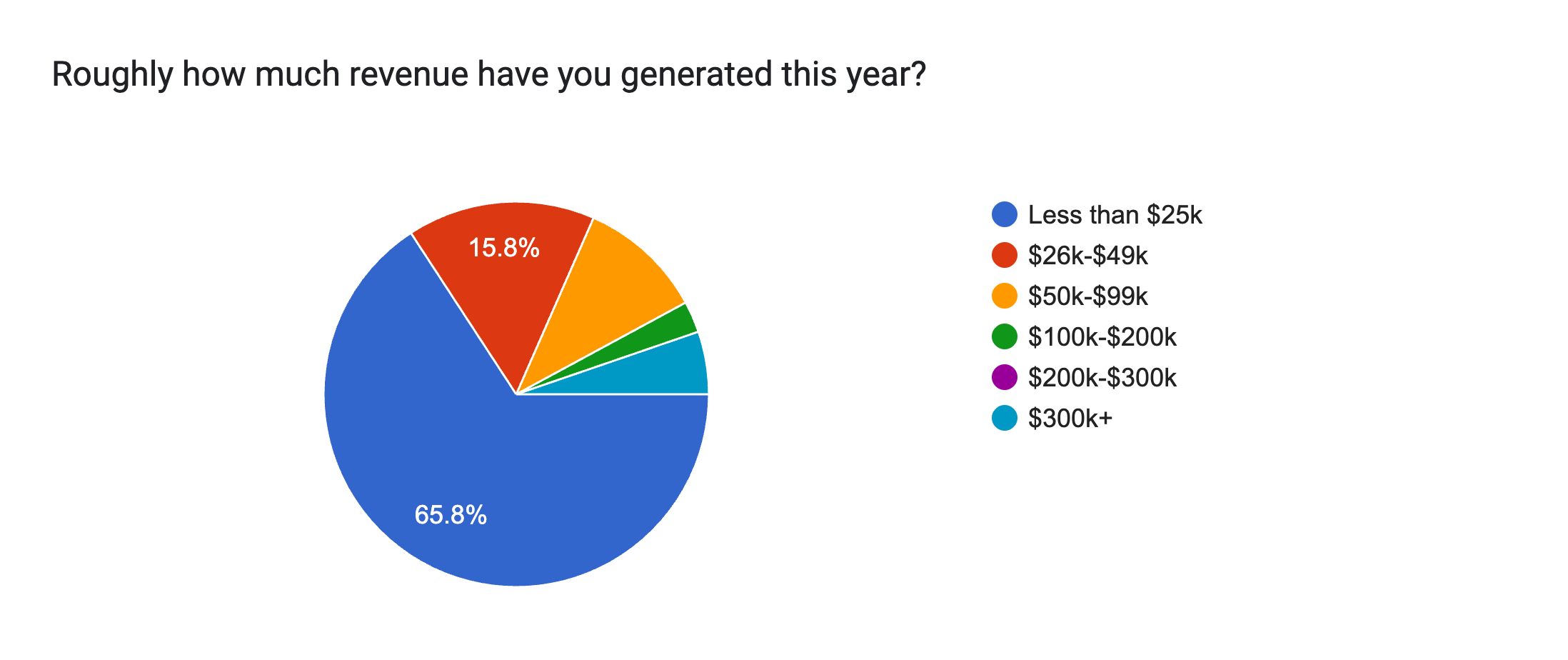
The majority of respondents fall into Stage 1 (under $25k), with smaller but meaningful representation from Stage 2 ($25k- $99k) and Stage 3 ($100k+) businesses. This distribution matters: it explains why early-stage pain points dominate—but also reveals how those pain points evolve rather than disappear as revenue increases.
As revenue increases if UNDERLYING problems aren’t addressed, they compound and cause even more strain on the founder as the business grows.
Key Findings (Emerging Patterns)
1.1 Sales and marketing are the loudest pressure points, regardless of revenue
When asked which areas of business feel most out of alignment, sales and marketing dominate across all stages.
The selections concentrate in four categories:
- Sales & Marketing: selected by ~66% overall
- Mindset & clarity: ~32% overall
- Time & energy management: ~29% overall
- Offers & pricing: ~24% overall
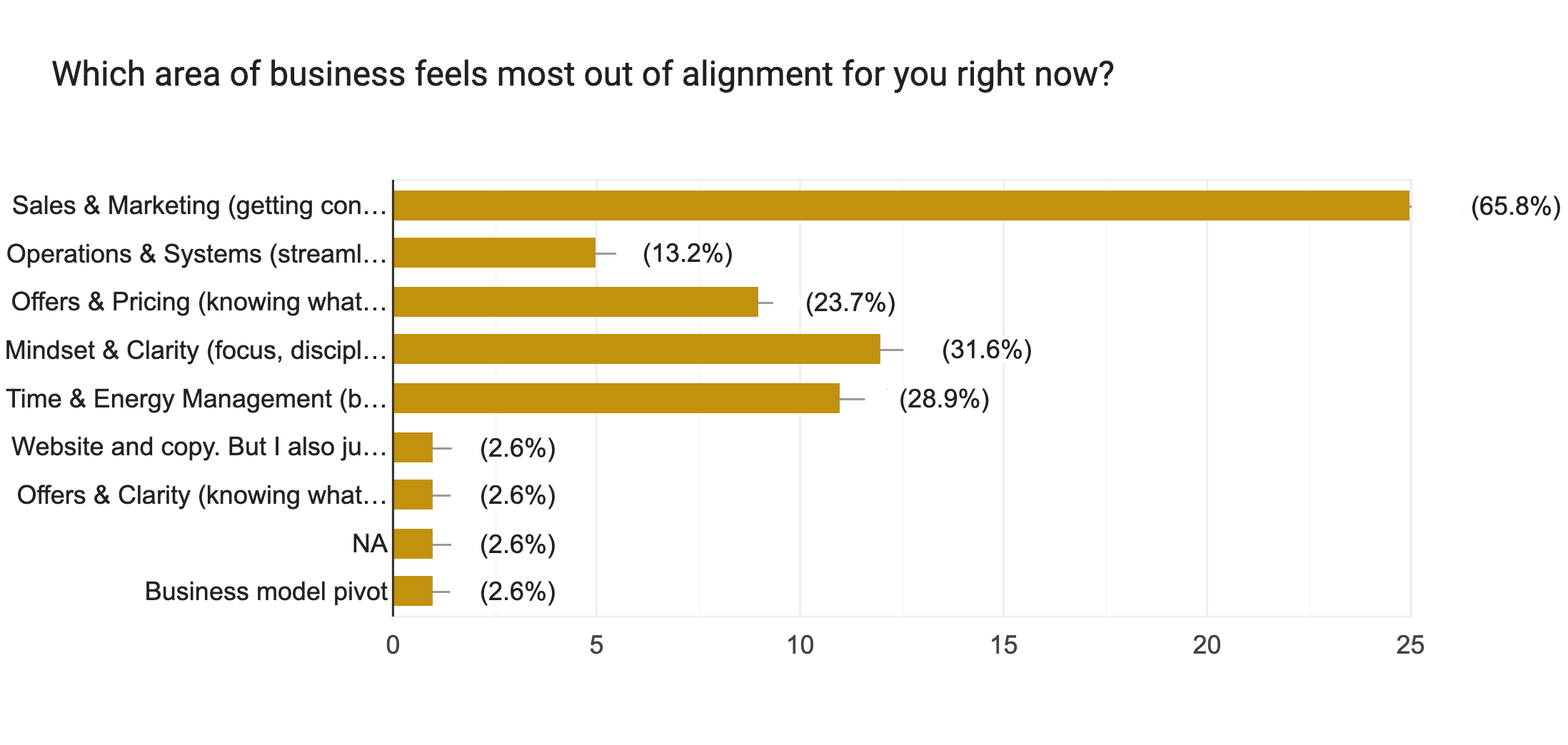
However, they rarely appear alone. Respondents were asked to select all that applied to them.
Stage differences sharpen the story:
- Stage 1: Sales & Marketing is dominant (~72%), but it frequently stacks with time/energy (~40%) and mindset (~40%).
- Stage 3: misalignment shifts away from “marketing” and toward operations/systems (~33%) and offers/pricing (~33%).
Pattern: Sales is not an isolated issue. It is the most visible pressure point where multiple unresolved business decisions converge. Earlier-stage moms feel the problem as “marketing,” while higher-stage moms more often experience the constraint as structure, delivery, and operational load.
1.2 Working fewer hours correlates with lower confidence, not higher clarity or optimized an optimized business/revenue
As much as people tout that they can “help you build your business in part time hours” the data shows that the amount of time worked is not reflective of business success OR fulfillment.
Hours worked per week vary sharply by stage:
- Stage 1: A large share works under 10 hours per week.
- Stage 2: Most cluster between 10–20 hours.
- Stage 3: Hours distribute more evenly across 10–40 hours.
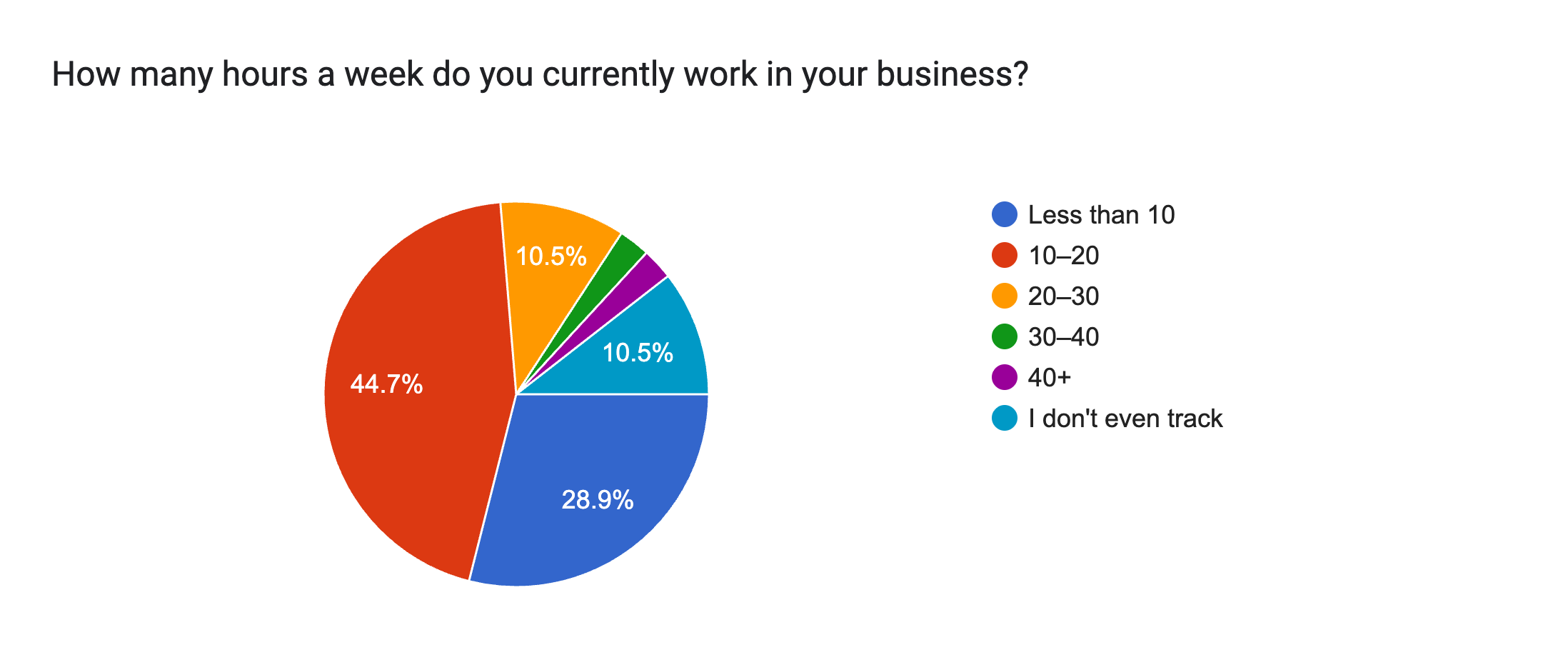
Interestingly all those who were in Stage 3 ($100k+) worked a MINIMUM of 20 hours and upwards of 40+ hours.
To further breakdown, all the moms who worked 40 hours noted they had full time (in-home) childcare and a team. These women made over $300k/year.
At the same time, sales messaging confidence rises with revenue:
- Stage 1 confidence average: ~3.9/10
- Stage 2 confidence average: ~6.6/10
- Stage 3 confidence average: ~7.7/10
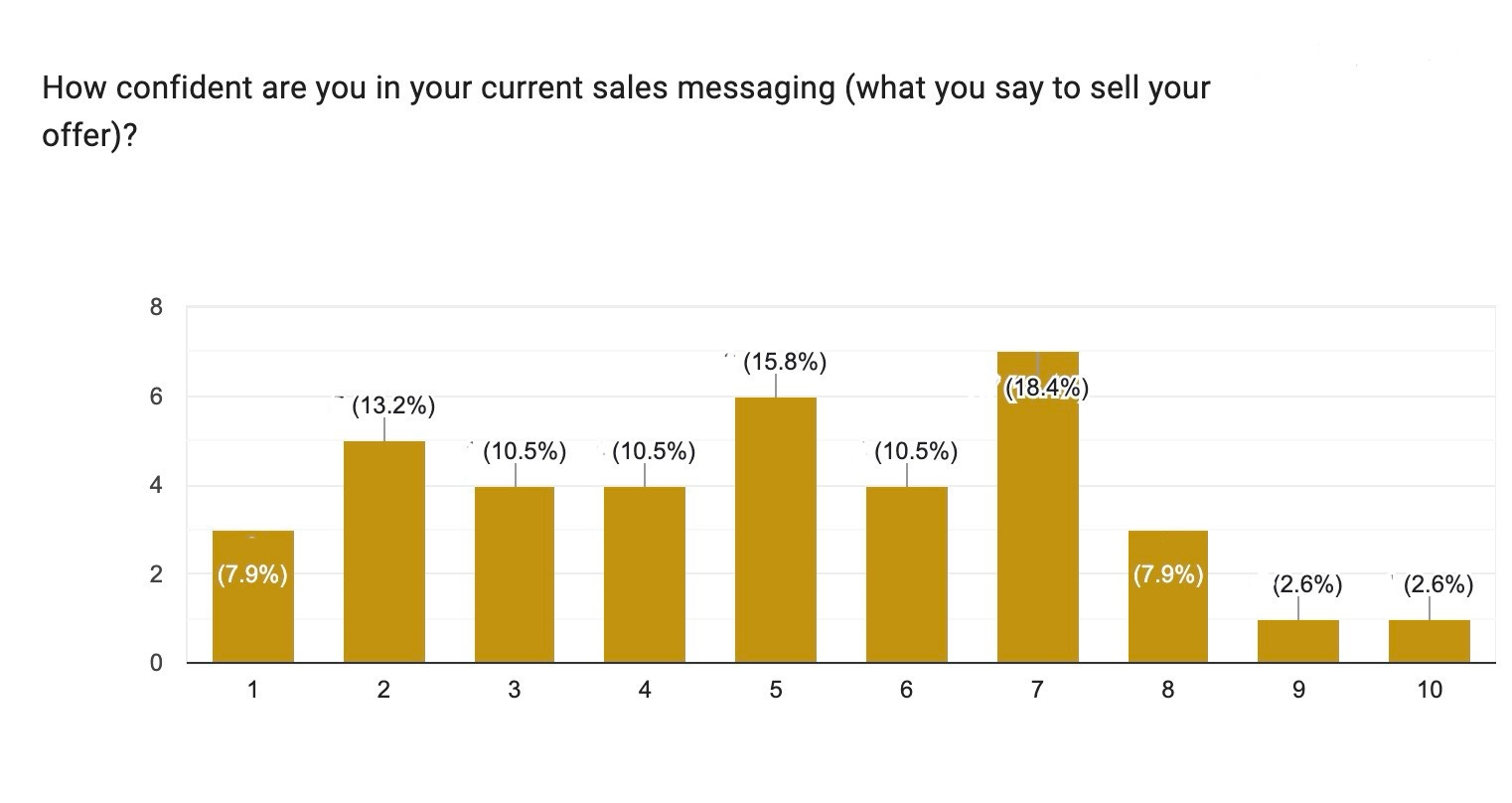
The more time respondents spent “working,” the more confident they felt in their sales messaging and strategy, which led to higher revenue.
Note: While this data reflects correlation rather than direct causation, the pattern strongly suggests that repetition via time spent and feedback (not motivation) drive sales fluency.
Pattern: Limited hours often reduce repetition, iteration, and feedback—slowing the development of sales fluency. Lower confidence is not primarily a mindset issue; it is often a rep issue, that shows up as lack of sales because of less iteration, fewer reps, and lower sales fluency.
1.3 The dominant “selling” pain is not one thing; it’s a cluster of execution + clarity + conversion
When describing what feels hardest about selling, responses cluster by stage:
Stage 1 (Under $25k):
- Conversion / getting buyers: ~32%
- Consistency / execution / overthinking: ~36%
- Messaging clarity / articulation: ~28%
- Asking / money discomfort: ~16%
- Visibility / reach / audience fit: ~16%
Stage 2 ($25k–$99k):
- Consistency / execution / overthinking: ~40%
- Messaging clarity: ~30%
- Conversion: ~30%
- Visibility/audience fit: ~30%
Stage 3 ($100k+):
- Themes concentrate around clarity + conversion + execution (each ~33%)
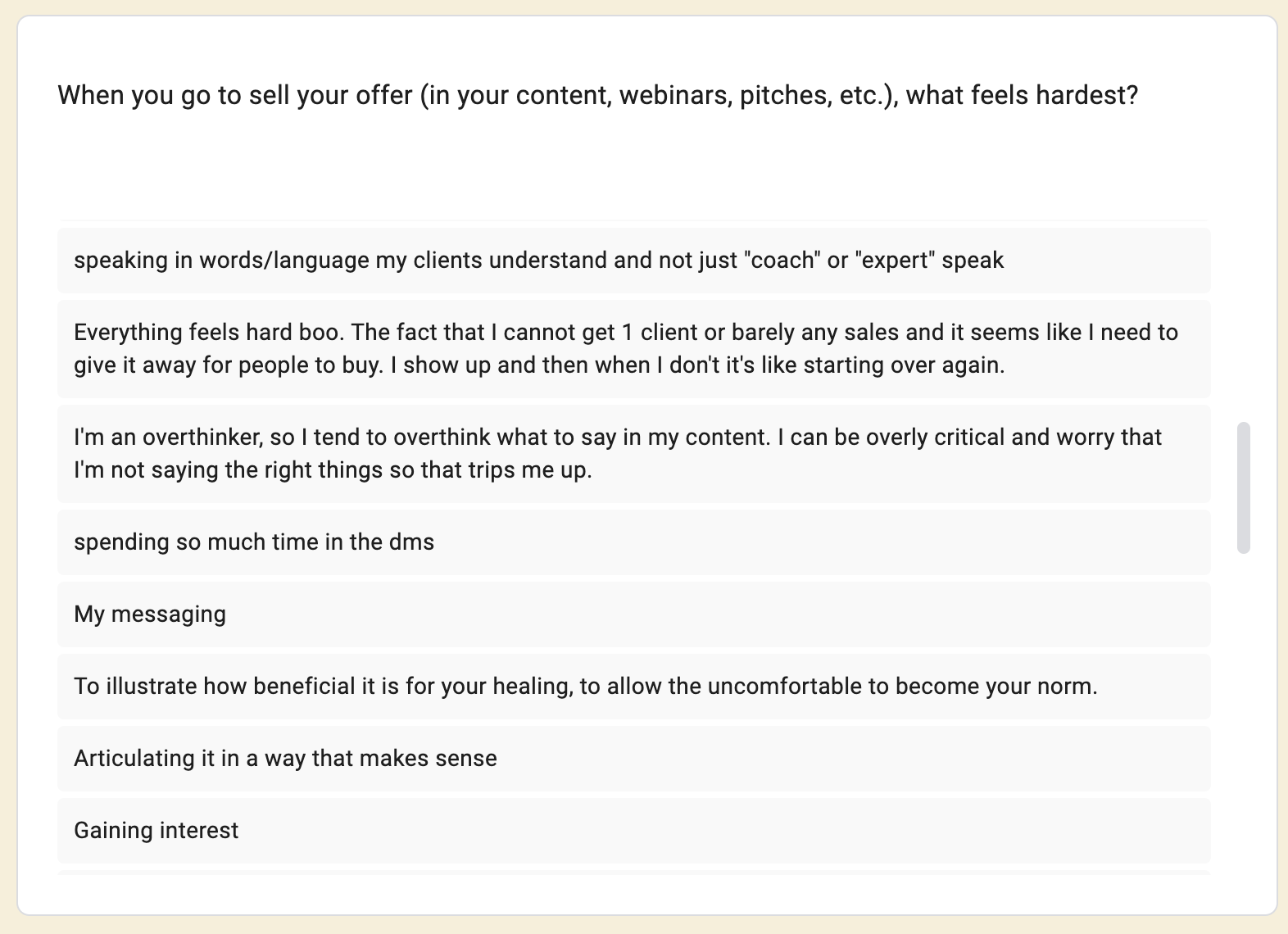
Interestingly over 80% of respondents noted that they have invested in some sort of templates, coaching, or digital product that helps with sales and yet they still have sales struggles.
Stage distinctions sharpen the insight among sales struggles:
- Stage 1 (under $25k): Conversion and clarity in message dominate their issues
- Stage 2: Execution and consistency rise to the top.
- Stage 3: Problems concentrate around refinement, efficiency, and delivery rather than visibility.
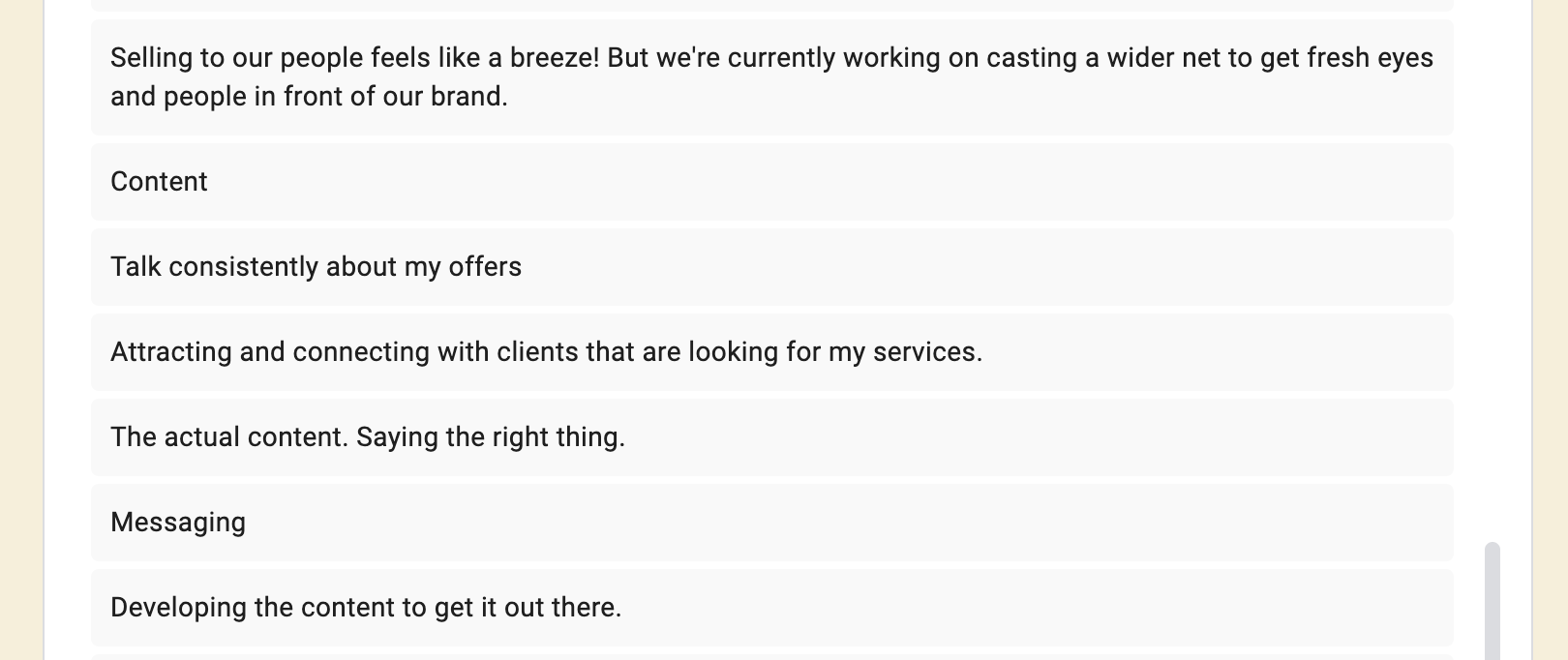
Pattern: Selling difficulty evolves by stage but rarely disappears. The problem shifts from “how do I sell?” to “how do I sustain this without overextension?” The core selling problem is not “confidence” alone—it’s sales execution under constraint, and in Stage 1 it’s also insufficient message precision.
An important note to make is that higher-earning respondents generally reported:
- Moderate to high confidence in messaging
- Some form of consistent demand
- A working lead source (content, referrals, platforms)
Yet even among these respondents:
- Sustainability was fragile
- Growth felt heavy
- Scaling raised new fears around time, energy, and leadership
This reveals a messaging ceiling:
You can only message your way through a structural problem for so long.
At a certain point, confidence is no longer built by better words—but by better decisions.
1.4 Prior Investments Were Often “Helpful but Incomplete”
The most common “I tried to fix it” behavior is consumption—then tools—then paid support. When asked what they’ve already tried, respondents overwhelmingly report high consumption and high tooling.
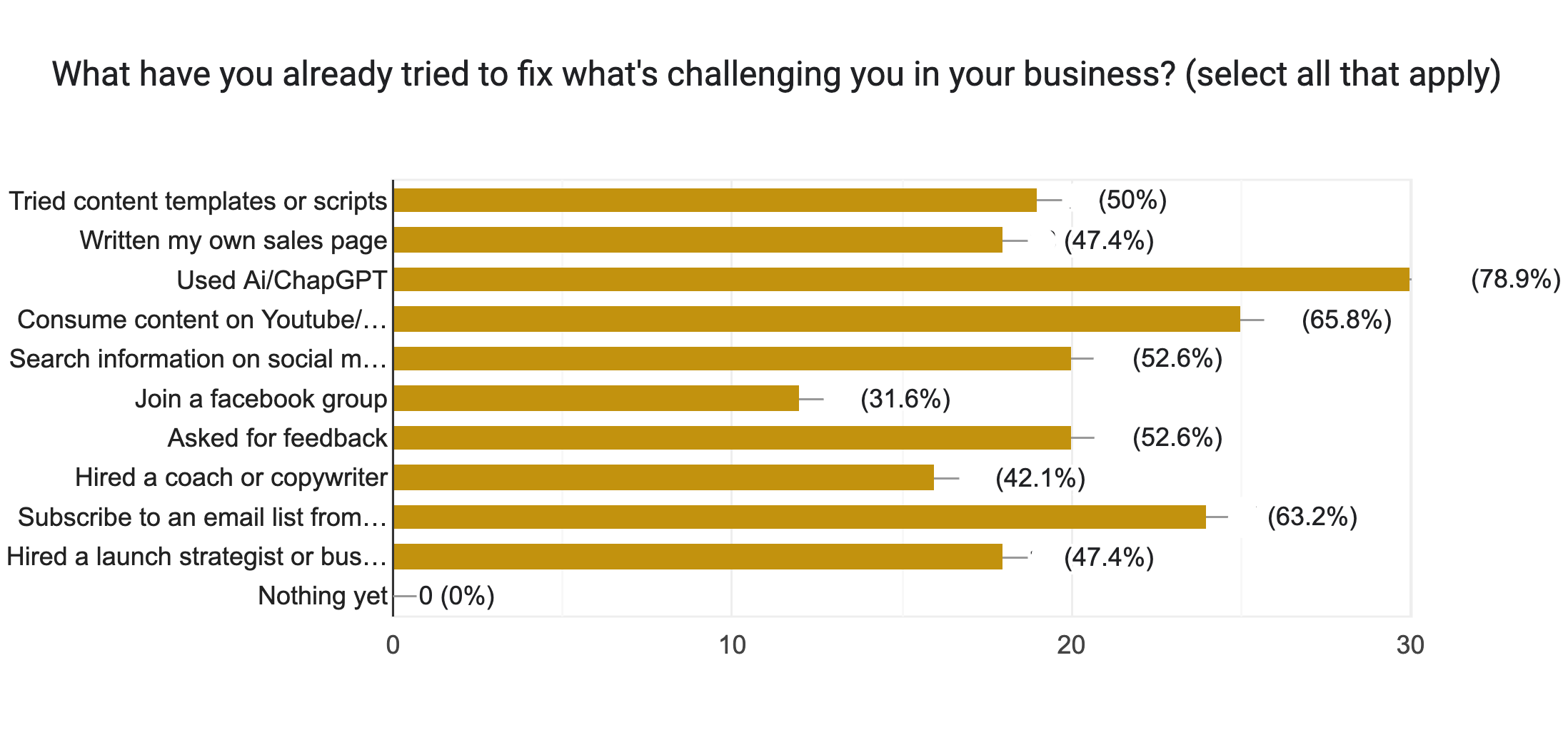
Overall top behaviors:
- Used AI/ChatGPT: ~79% overall (Stage 1: ~84%, Stage 2: ~80%)
- Consumed YouTube/podcasts/blogs: ~66% overall
- Subscribed to expert email lists: ~63% overall
- Searched IG/TikTok for answers: ~53% overall
- Asked for feedback: ~53% overall
- Tried templates/scripts: ~50% overall
- Wrote their own sales page: ~47% overall
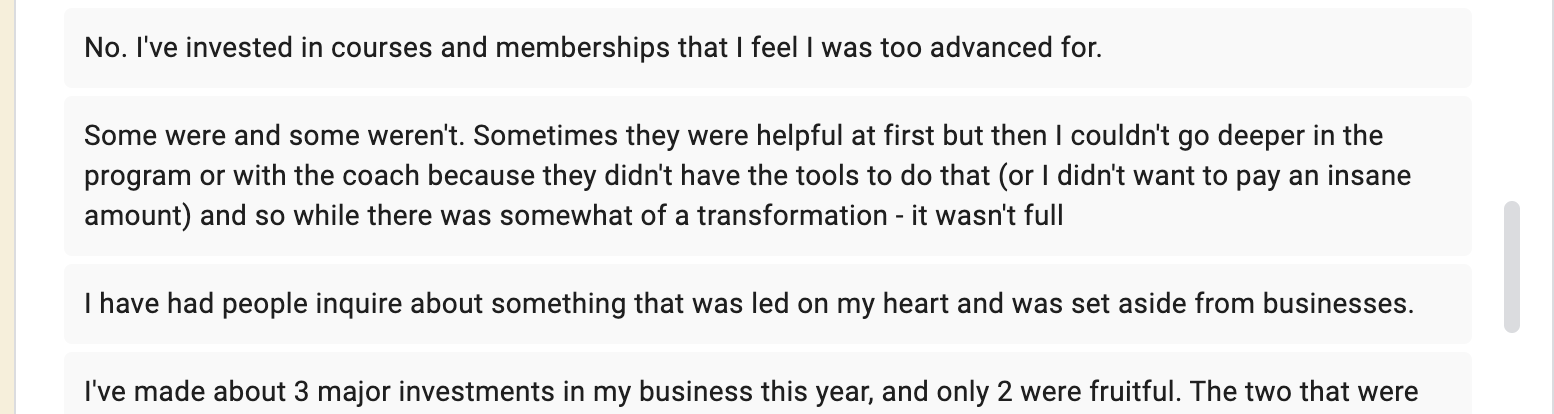
When respondents were asked about their investments in 2025 there was a mixed response with most erring on feeling their investments were lacking on implementation or not what they needed.
It’s worth it to note that, Stage 2 ($25k-$99k) respondents are especially likely to have hired coaches or strategists (~80–90%), suggesting that spending is happening, yet many still report unresolved friction.
Stage 3 ($100k+) respondents hire team and tend to stick with an advisory board of experts that they rotate through for support ongoing.
Pattern: The issue is not access to information. It is fragmentation (learning in pieces) without integration into a coherent operating model.
The issue was not lack of effort or discernment.
Most investments addressed:
- One part of the business
- One season of growth
- One perspective
Few addressed the business as an integrated system that must serve a mother’s real capacity over time.
(small note: we found that over 80% of the respondents in Stage 3 making $100k+ chose a mentor or group of mentors and worked with them for several years/”rounds” and they attribute having support long term from trusted advisors for their success.)
1.4b Emerging sub-pattern: unclear decision ownership compounds strain
Across stages, respondents described overthinking, stalled execution, and reliance on external inputs (templates, coaches, AI) without clear internal decision authority.
This suggests that many businesses lack defined ownership over key decisions (messaging, offers, priorities) which increases cognitive load and slows integration.
Aka: In many cases, progress slowed not because moms didn’t know what to do, but because too many outside voices made it hard to decide what to do next.
1.5 Content demand shifts with revenue stage
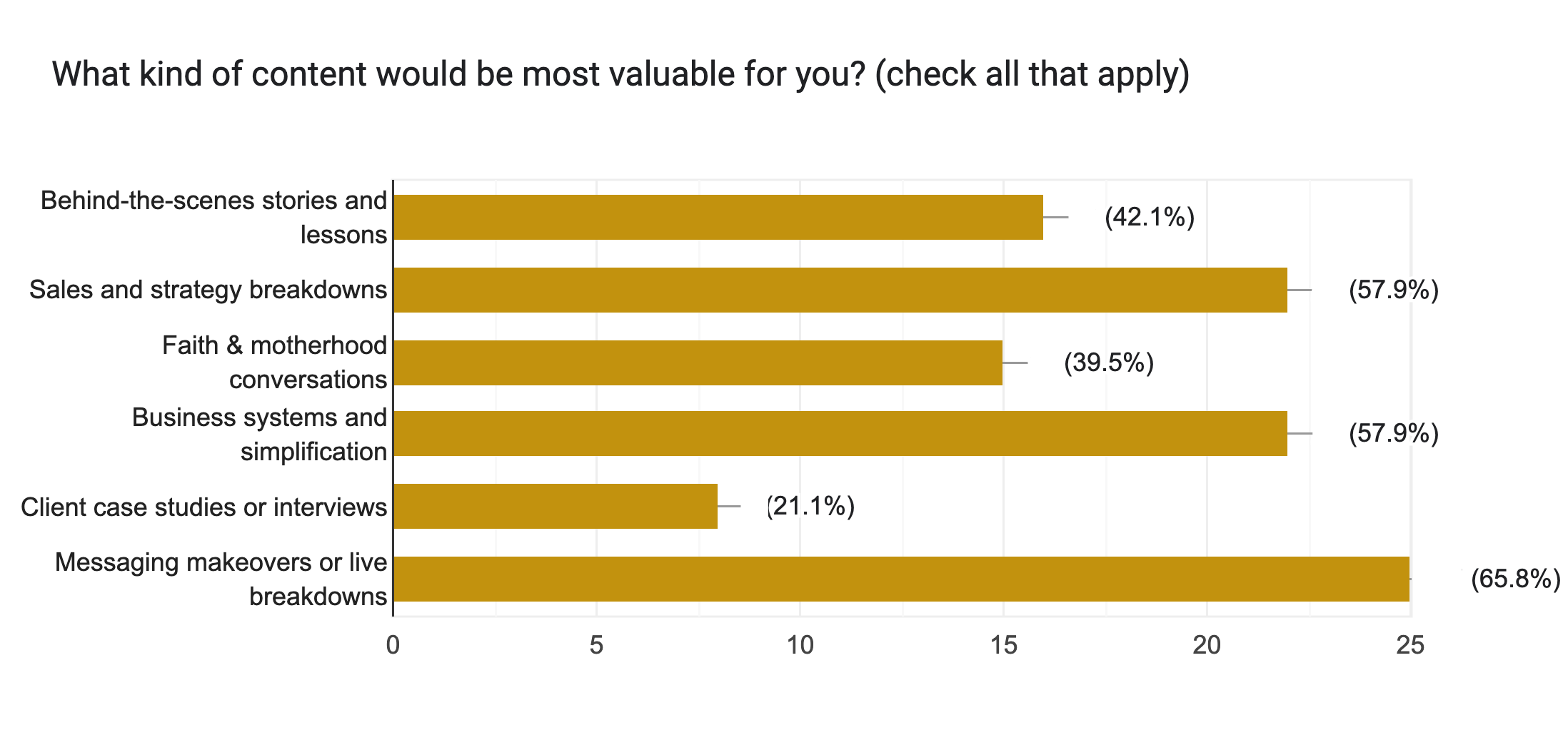
When asked what content would be most valuable in 2026:
- Early-stage respondents prioritize messaging makeovers and clarity
- Mid-stage respondents prioritize sales breakdowns and systems
- Higher-stage respondents prioritize behind-the-scenes leadership and decision-making
Pattern: As revenue increases, the need shifts from instruction → execution → leadership perspective.
The 2026 Reality: Moms Are Not Under-Skilled—They Are Over-Extended
This data supports a reframing that challenges much of the online business narrative:
Moms do not need more information.
They need fewer decisions, clearer ownership, and models that protect profit—not just generate it.
The businesses that will thrive in 2026 will:
- Prioritize revenue and profit
- Capacity-aware, not hustle-optimized
- Built around decision clarity, not personality
- Designed to function even when the founder is tired, unavailable, or offline
Authority in this next era will belong to leaders who can:
- Diagnose why a business feels heavy
- Simplify without shrinking ambition
- Design systems that honor both motherhood and profit
What These Patterns Mean
2.1 Sales is an early warning system, the underlying problem is business design under constraint
Because sales & marketing is selected by ~66%, it would be easy to conclude “moms need more marketing and sales offers/resources.”
But the same respondents also select the following as their struggles:
- Time/energy (~29%)
- Mindset/clarity (~32%)
- Offers/pricing (~24%)
Meaning: the issue is not marketing in isolation. It’s that the business model requires a version of the founder that doesn’t reliably exist (unlimited energy, uninterrupted time, consistent output).
Sales friction is often the bill that comes due when the business isn’t built for the founder’s actual capacity.
Sales and marketing feel hardest because that is where misalignment becomes visible first.
It is immediately clear when there is a lack of sales or inconsistency in marketing.
It’s less clear when offers are unsustainable, time is fragmented, or systems are weak.
In that case, sales absorbs the strain and marketing gets the blame.
This explains why “sales problems” persist even after:
- Investing in templates and coaching
- Creating more content or marketing effort
- Better scripts
- Increased visibility
Sales pressure often signals structural misalignment upstream (a flaw in the underlying business model or strategy).
2.2 Confidence follows clarity and repetition, not motivation. Doing MORE work (within reason) is required
A finding that might get the girls in a tizzy is that working less is not a sign of maturity in business.
All the respondents in Stage 3 ($100k+), average 20-40 hours per week and showed high confidence in their sales strategy. They felt motivated because of repetition that led to high sales and confidence.
(Note: There were 2 outliers to this data that made over $250k and worked less than 20 hours per week. They noted an extensive team of contractors or employees and that their business model included co-coaches and other support because they were in a restructuring season. This data was not included to keep this report clean.)
The confidence gap across income stages suggests that belief is built through:
- Repeated language
- Predictable objections
- Clear positioning
- Feedback loops
Without enough selling reps—often due to limited time—confidence stagnates. This reframes confidence and sales as a capacity-dependent skill, not a personality trait.
2.3 The market has created “educated confusion”: high information, low integration
With ~79% using AI and ~66% consuming long-form content for answers, the problem is not access.
Buyers KNOW a lot and even have a few pretty templates to implement for a week or a couple months but then friction happens that leads to educated confusion (knowing but unable to do for xyz reason):
- Moms know what to do
- They struggle to decide what matters most
- They lack a unifying model to reduce decision fatigue
This is why integration—not inspiration—is the dominant unmet need.
The data showed that:
- Level 1 (under $25k) are willing to invest up to $1000 in 2026
- Level 2 ($25k-$99k) are willing to invest in masterminds and group coaching (they seem to cap around $3000 for one investment
- Level 3 ($100k+) want to invest in team, skills, and strategists that can 10x their investment
2.4 Each income stage is fighting a different enemy and solving a different problem
- Stage 1: Creating dependable demand with limited time
- enemy = inconsistent demand for their work + unclear sales language to communicate what they do
- lived reality = limited hours + low reps + scattered learning
- Stage 2: the messy middle
- enemy = execution under capacity + scaling consistency
- they’re more likely to have invested in support, but they still report overthinking and inconsistent selling
- Stage 3: “marketing” isn’t the loudest pain; the constraint becomes systems, delegation, and offer structure
- enemy = operational load and delivery structure
- desire = Sustaining profit while reducing founder dependency
It’s also important to note that higher-revenue respondents represent businesses that have survived long enough to encounter operational strain (meaning their challenges are not failures, but byproducts of growth).
Treating all stages as if they need the same advice flattens the problem and delays resolution.
Depending on which stage you’re working, it is important to know what their core problem is.
2.5 “Balance” satisfaction rises with revenue, but it’s not automatic—it’s structural
Reported balance satisfaction increases with revenue—but not automatically.
Importantly, increased revenue alone does not create balance. The data suggests balance emerges when revenue is paired with structural leverage—systems, delivery design, and decision clarity.
Balance satisfaction averages:
- Stage 1: ~4.4/10
- Stage 2: ~5.9/10
- Stage 3: ~8.7/10
Balance emerges when:
- Delivery is designed intentionally
- Decisions are fewer and clearer
- Systems absorb variability
Balance is a business outcome, not a moral achievement.
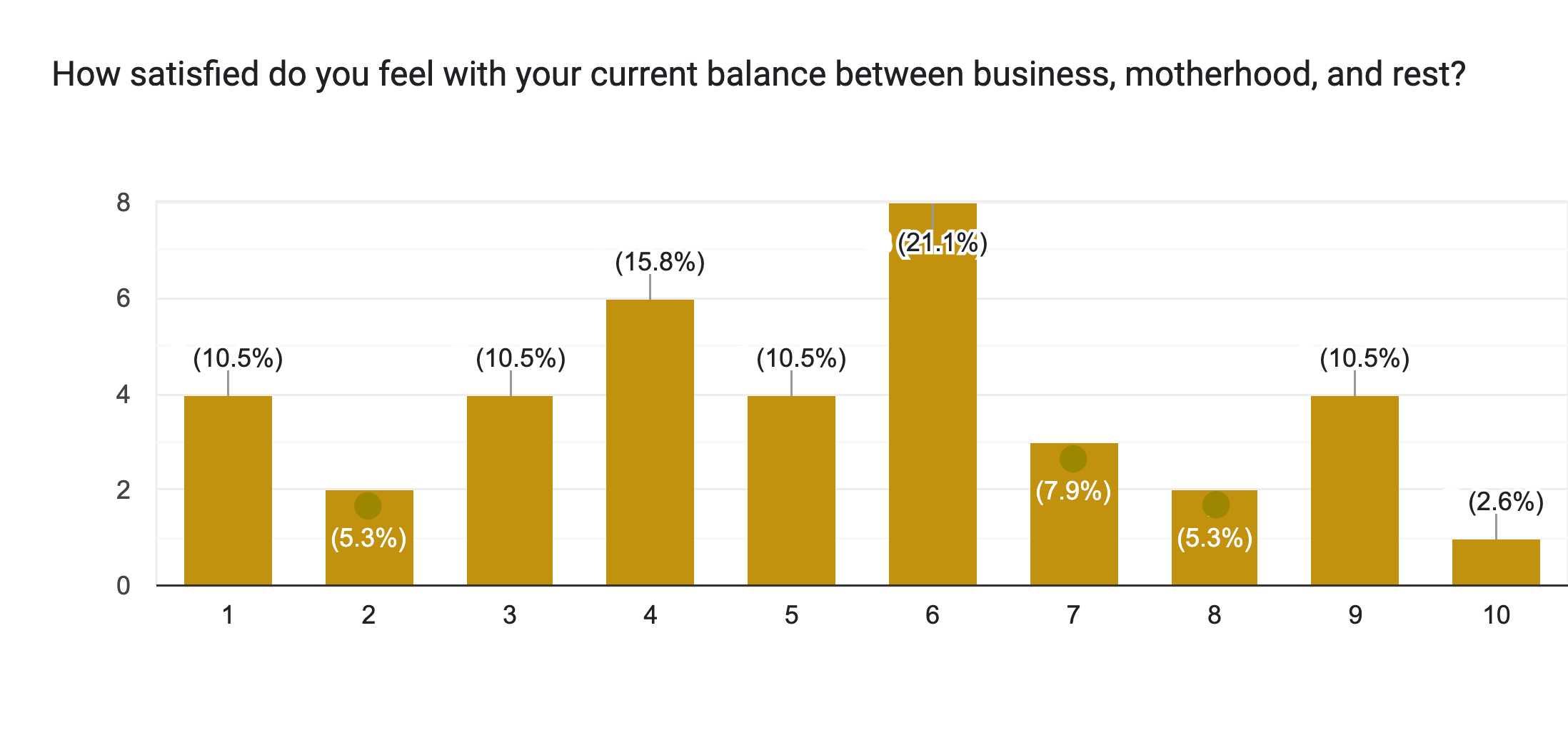
Going back to hours worked. Roughly 70% of respondents in Stage 3 ($100k+) reported working a minimum of 20 hours/week.
Meaning: sustainable balance is less about “working less” and more about:
- leverage
- clarity
- systems
- stable demand
Building the proper capacity and profit systems will create a more satisfied MamaCEO regardless of how many hours you work.
What Leaders Should Do in 2026
3.1 Teach stage-based business design, not universal tactics
Leaders must stop prescribing “more marketing” as a default solution.
Instead:
- Stage 1 needs sales foundations and reps
- Stage 2 needs consistency systems and simplification
- Stage 3 needs operational leverage and leadership clarity
Authority comes from diagnosis, not volume of advice.
Find a core message or central theme and go DEEP on that versus teaching a disjointed framework or tips.
3.2 Treat sales fluency as a capacity skill
Because confidence correlates with revenue, leaders should learn and teach:
- Repeatable sales language
- Clear transformation statements
- Predictable conversion paths
Messaging makeovers are in demand because they reduce cognitive load and accelerate fluency.
There is also a rise in the need for brand strategy (we highly recommend Rose Loreston).
Confidence in business can be taught tangibly. Given the confidence gap (3.9 vs 6.6 vs 7.7), leaders should stop framing confidence as mindset and start teaching it as:
- repeated language
- predictable objections
- clear transformation statements
- scripted sales pathways
This directly matches why ~66% want messaging makeovers. It gives people the language and framework they need to easily communicate their genius to their buyers.
The more you can do to learn skills that can then become a template or framework in your business, the more confident you will feel and be able to increase in your skills and capacity.
Note for leaders: This thought lends itself perfectly to case studies and before/afters. Regardless of what your offer/niche is, the data shows that people need support with skills and to see how their skills or results will improve upon hiring you.
Secondary note for service providers: You are not exempt from case studies, show your body of work via transformation content and that will give people the CONFIDENCE to invest in your services ongoing.
3.3 Design integration, not just education or inspiration
Given high content consumption, leaders must move beyond teaching isolated tactics and instead model:
- Offer → message → funnel → workflow alignment
- Decision reduction
- Business-wide coherence
This is where frameworks outperform tips.
The key is that frameworks MUST produce results and have a clear process for results.
Buyers are looking for support with implementation which is a huge plus for service providers or coaches/consultants who want to add services.
3.4 Shift success metrics from visibility to conversion stability
Engagement without conversion remains a dominant frustration. It’s “easy” to get attention and views and not as easy to convert that traffic.
“Engagement but not conversion” appeared repeatedly in our survey in the stage statements (Stage 1: ~64%), as leaders we must retrain the market:
- content that “does well” is not the goal
- conversion clarity (someone being able to KNOW they want to go to the next step and be able to identify the next step in working with you) is the goal
- follow-up systems are the goal
Action recommendation: normalize conversion tracking and simple KPIs:
- Inquiry tracking
- Follow-up rhythms
- Close rates
- Time-to-sale metrics
Visibility is not the goal. Stability is.
3.5 Focus on profit protection and capacity alignment ASAP
As revenue grows, unresolved delivery and leadership issues compound. Leaders should focus on:
- Simplification (fewer offers, fewer decisions)
- Delivery design of your offers (reducing time cost per client)
- Pricing that matches capacity
- Capacity math and mapping (identifying and knowing your capacity and how to build around it)
- Founder dependency reduction (no more being the bottleneck and having a business that relies on your constant doing)
- Decision ownership and confidence
- Systems that reduce cognitive load
These are not “advanced” topics—they are preventative ones.
Income Stage Summary
Stage 1 — Under $25k
Primary struggle: clarity, conversion, consistency
Primary need: sales fluency and foundational structure
What they’re most likely struggling with
- Sales & marketing misalignment (~72%)
- Lower sales messaging confidence (~3.9/10)
- Conversion + consistency themes dominate selling difficulty
What they turn to
- AI (~84%)
- long-form consumption (~68%)
- email list learning (~60%)
- scripts/templates (~48%)
How to serve them
- messaging makeovers (~72%)
- systems & simplification (~56%)
- sales breakdowns (~52%)
- plus faith/motherhood integration (~52%)
Our Recommendation if you’re here:
- 1 offer statement
- 1 sales script
- 1 follow-up rhythm
- 1 content cadence tied to a conversion action
Stage 2 — $25k–$99k : execution under constraint
Primary need: simplification, systems, consistency
What they’re most likely struggling with
- Sales breakdowns + systems are top content needs (80% / 70%)
- Overthinking/execution remains dominant (~40%)
What they turn to
- high likelihood of hiring support (coach/strategist ~80–90%)
- still high reliance on templates and consumption
Our Recommendation if you’re here:
- simplify offer suite
- create a selling system that runs weekly regardless of life
- tighten messaging to improve conversion efficiency (not “post more”)
Stage 3 — $100k+: Operations, delivery, and leadership structure
Primary struggle: operational load and leadership capacity
Primary need: leverage, delivery redesign, profit protection
What they’re most likely struggling with
- time/capacity strain shows up heavily in open-ended responses
- alignment issues lean operational (systems and offer structure)
What they want
- behind-the-scenes decision-making (~67%)
Our Recommendation if you’re here:
- restructure for profit protection
- reduce founder dependency
- formalize decision ownership and client fulfillment systems
- strategic partnership for advisory support for all the above
Closing Perspective
The 2026 State of Moms in Business data makes one thing clear: moms are not under-motivated, under-skilled, or under-informed.
They are navigating businesses that were rarely designed for the realities of motherhood, leadership, and long-term sustainability.
Sales reveals the cracks first, but the solution is always broader than sales alone.
Thank you for reading the 2026 State of Moms in Business Report, consider subscribing to our email list so you can be part of our 2027 data!


